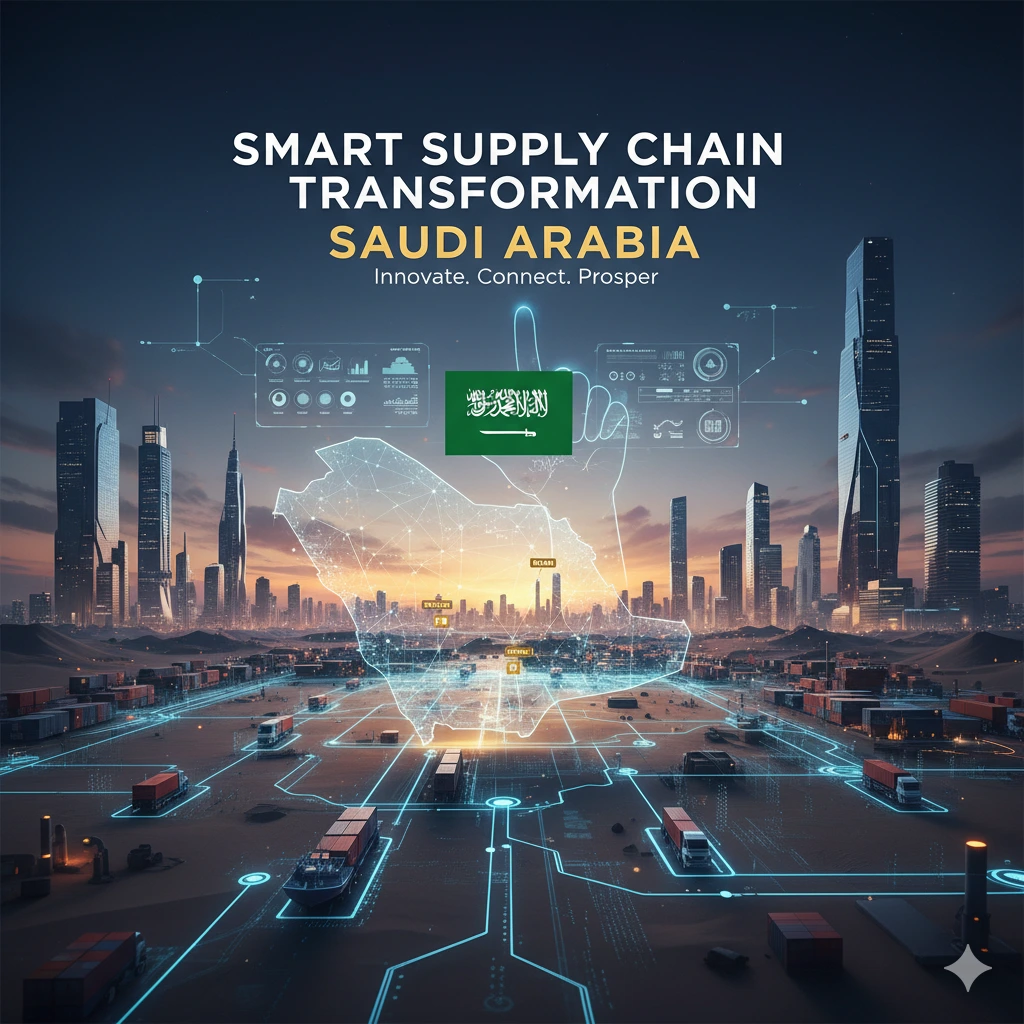
Smart Supply Chain Transformation in Saudi Arabia
Across logistics hubs in Riyadh, industrial zones in Dammam, and ports serving Jubail and Yanbu, supply chain leaders face mounting pressure. Delays are costly. Inventory visibility is limited. Coordination between factories, warehouses, and transport fleets often relies on fragmented systems.
Saudi Arabia’s ambition to become a global logistics hub under Vision 2030 has raised the bar. Traditional supply chain models, built on spreadsheets and delayed reporting, cannot scale to meet modern demands.
The Smart Supply Chain, powered by Industrial IoT, real time data, and analytics, is now a strategic necessity for manufacturers, logistics providers, and government stakeholders across the Kingdom.
Why Smart Supply Chain Matters in the Kingdom
Saudi supply chains operate across vast geographic distances. Raw materials move from ports to factories. Finished goods travel to distribution centers, retailers, or export terminals. Any lack of visibility creates inefficiencies that multiply downstream.
A Smart Supply Chain replaces assumptions with data. Assets, inventory, and shipments are tracked in real time. Decisions are based on facts, not estimates.
For organizations aligned with NIDLP, supported by SIDF, or integrated into Aramco and SABIC supply networks, digital traceability is increasingly mandatory.
Strategic Value for Business Leaders
- End to end visibility across suppliers, warehouses, and transport
- Reduction of inventory holding costs
- Improved delivery reliability and customer satisfaction
- Faster response to disruptions and demand changes
In competitive sectors such as petrochemicals, food processing, and construction materials, Smart Supply Chain capabilities directly impact profitability.
National and Academic Importance
Universities such as KFUPM and KSU increasingly focus on logistics engineering, data analytics, and industrial systems integration.
From a national perspective, SDAIA views supply chain data as critical for economic resilience. Smart Supply Chain platforms generate trusted datasets that support planning, forecasting, and AI driven optimization.
The Technical Architecture of a Smart Supply Chain
Asset and Inventory Tracking Layer
The foundation of a Smart Supply Chain is real time tracking of physical assets.
- IoT sensors for pallet and container tracking
- RFID tags for inventory identification
- Environmental sensors for temperature and humidity monitoring
- GPS modules for fleet and shipment visibility
In Saudi Arabia’s climate, sensors must tolerate heat, vibration, and long operating cycles without maintenance.
Edge Devices and Local Intelligence
Data from sensors is processed at the edge using industrial gateways. Platforms based on Raspberry Pi or industrial embedded computers act as aggregation points.
Low power sensing nodes frequently rely on ESP32 microcontrollers, especially in large warehouses or container yards where battery life is critical.
Integration with existing automation and ERP systems is achieved using standard industrial interfaces.
Connectivity Across Saudi Supply Chains
Connectivity requirements vary depending on location and asset mobility.
- MQTT for efficient event driven communication
- LoRaWAN for large warehouses, yards, and industrial campuses
- Cellular networks for long haul transportation
- Industrial Ethernet within factories and distribution centers
In logistics hubs near Khobar and Jubail ports, hybrid connectivity architectures are common.
Data Platforms and Supply Chain Analytics
Data flows into centralized platforms where it is stored, visualized, and analyzed. Dashboards provide real time insights into inventory levels, shipment status, and bottlenecks.
Advanced analytics and AI models support demand forecasting, route optimization, and anomaly detection.
Real World Saudi Scenario
Industrial Warehouse Network in Riyadh
A manufacturing group operating multiple warehouses in Riyadh faced frequent stock mismatches and delayed replenishment.
IoT enabled RFID and environmental sensors were deployed across storage zones. ESP32 based nodes transmitted data to edge gateways using MQTT. Inventory levels became visible in real time.
Replenishment cycles were optimized. Inventory carrying costs dropped by 20 percent within the first year.
Challenges in Saudi Smart Supply Chain Deployments
Environmental and Operational Conditions
Extreme heat impacts batteries and electronics. Hardware must be selected and installed with proper thermal management and enclosure ratings.
System Integration Complexity
Many organizations operate legacy ERP and warehouse management systems. Integration requires careful data modeling and middleware design.
Workforce Readiness
Smart Supply Chains require professionals skilled in logistics, IT, and data analytics. Training and local capability building remain critical success factors.
Smart Supply Chain as a Vision 2030 Pillar
Smart Supply Chain initiatives directly support Vision 2030 objectives for logistics excellence, industrial efficiency, and global competitiveness.
Programs under NIDLP, guidance from Modon, and data strategies led by SDAIA all emphasize supply chain digitalization.
For official references, visit Vision 2030 and SDAIA.
Build a Smart Supply Chain with IIoT-Bay
A Smart Supply Chain depends on reliable hardware, scalable connectivity, and proven architectures.
Discover industrial IoT sensors, gateways, and end to end solutions at IIoT-Bay or schedule a consultation via IIoT-Bay Services.
Conclusion
Industrial IoT represents a strategic opportunity for Saudi factories to improve operational efficiency, reduce costs, and support Vision 2030 goals. By adopting modern technologies and best practices, industrial companies can achieve sustainable competitive advantage.
For personalized consultation on implementing Industrial IoT solutions in your facility, contact the IIoT-Bay team.