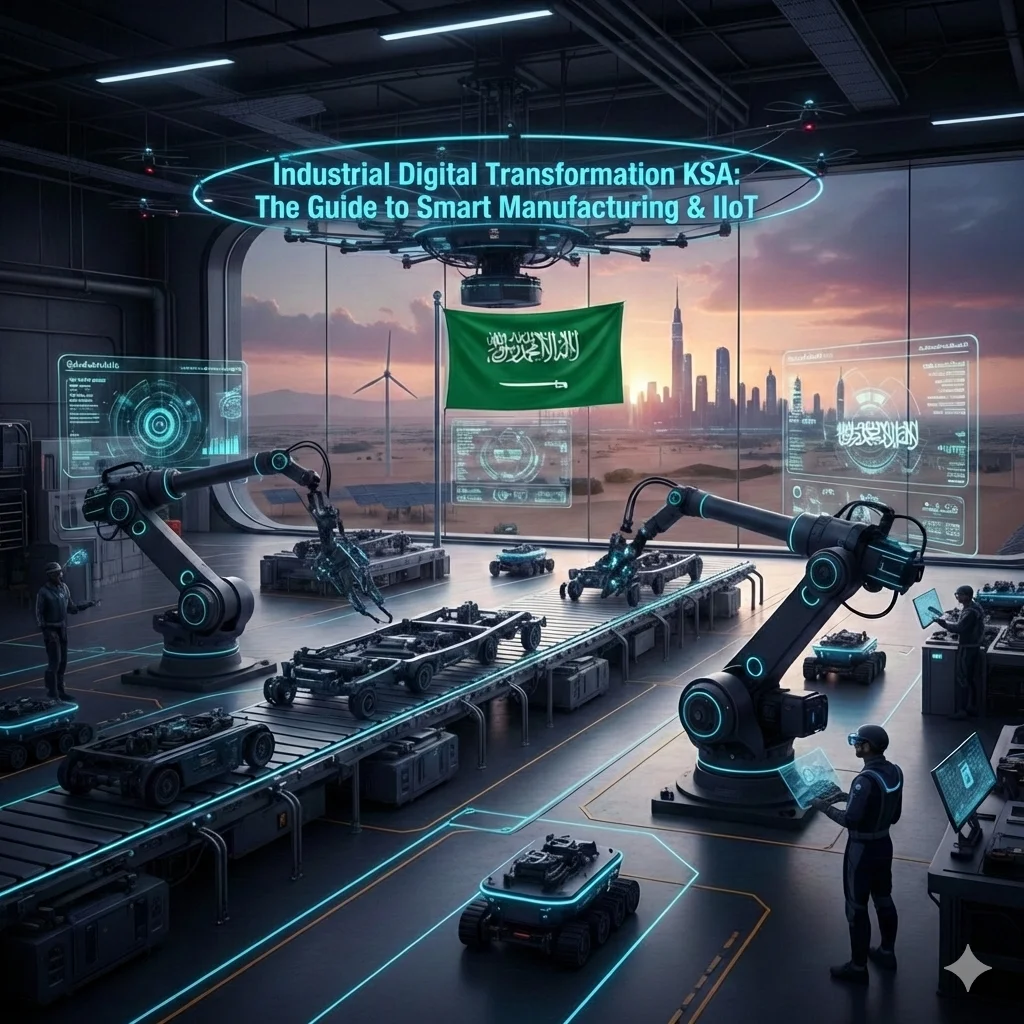
The Smart Factory Frontier: Driving Saudi Arabia's Industrial Digital Transformation in 2026
In the high-stakes manufacturing corridors of Dammam Second Industrial City and the petrochemical clusters of Jubail, a silent shift is occurring. For decades, these facilities relied on manual oversight and scheduled maintenance that often arrived too late. Today, the challenge has evolved. Industrial leaders face rising operational costs and a shrinking window for unplanned downtime. The traditional "run-to-fail" model is no longer sustainable in a market shaped by the ambitious targets of Saudi Vision 2030. The pressure to localize production and enhance global competitiveness is driving a surge in Industrial Digital Transformation KSA.
The core problem is visibility. Many Saudi plants still operate with "data silos" where Siemens PLCs or legacy Modbus controllers manage machines in isolation. Without a unified data layer, plant managers cannot accurately calculate Overall Equipment Effectiveness (OEE) or predict a bearing failure before it halts a production line. Bridging this gap requires a sophisticated integration of IoT Sensors in Riyadh and beyond, turning raw industrial noise into actionable intelligence.
Why IIoT is the Backbone of the National Industrial Strategy
The economic logic for adopting the Industrial Internet of Things (IIoT) is undeniable. By 2026, the Smart Factory Saudi Arabia market has become a central pillar for the Future Factories Program, an initiative by the Ministry of Industry and Mineral Resources to transform 4,000 factories into tech-driven hubs. For stakeholders, the value proposition is three-fold:
- Operational Efficiency: Real-time monitoring of energy consumption and machine health reduces waste and lowers the carbon footprint, aligning with the Saudi Green Initiative.
- ROI and Workforce Evolution: Transitioning from labor-intensive processes to automated, AI-driven systems allows Saudi talent to move into high-value roles such as Data Scientists and IIoT Architects.
- Supply Chain Resilience: Integrating MES (Manufacturing Execution Systems) with IIoT ensures that production schedules in Yanbu are perfectly synchronized with logistics hubs in King Abdullah Economic City (KAEC).
Technical Deep Dive: The Architecture of a Saudi IIoT Ecosystem
A robust industrial deployment is not just about "connecting things". It is a layered architecture designed for the harsh environments of the Arabian Peninsula. At IIoT Bay, we focus on a four-tier framework:
1. The Perception Layer (Sensors & Actuators)
Everything starts at the edge. We deploy high-precision sensors—vibration, ultrasonic, and thermal—to monitor assets. For legacy equipment, we often use ESP32 based custom nodes or industrial-grade Raspberry Pi enclosures to bridge the gap between old hardware and new networks.
2. The Edge & Connectivity Layer
Data is processed locally using Edge AI to minimize latency. Given the vast distances in the Kingdom, we utilize LoRaWAN for wide-area sensor coverage and OPC UA for secure, vendor-neutral communication between PLCs. For high-bandwidth applications, 5G private networks are now the standard in NEOM and Riyadh industrial zones.
3. The Middleware & Protocol Layer
We rely on MQTT (Message Queuing Telemetry Transport) for its lightweight footprint and "publish-subscribe" model, which is ideal for intermittent connectivity. This data is then funneled into Time-Series Databases like InfluxDB, optimized for handling the millions of data points generated by a single factory floor.
4. The Analytics & Visualization Layer
The final stage involves pushing data to a centralized SCADA or a cloud-based digital twin. Here, machine learning models analyze historical patterns to provide Predictive Maintenance alerts, informing technicians in Al-Khobar of a potential issue weeks before it happens.
Case Study: Predictive Maintenance in a Jubail Petrochemical Plant
Consider a large-scale polymer processing plant in Jubail Industrial City. The facility struggled with frequent failures in high-pressure pumps. Each hour of downtime cost the company upwards of 200,000 SAR.
The solution involved installing 150 wireless vibration and temperature sensors across the pump fleet. These sensors communicated via a LoRaWAN gateway to an on-site Edge Server. By implementing an AI-driven condition monitoring system, the plant was able to detect "cavitation" patterns—tiny bubbles that damage pump impellers—well before manual inspections would have caught them.
"Within the first six months, the system prevented three catastrophic pump failures, resulting in a documented savings of 4.2 million SAR and a 12% increase in annual OEE."
Navigating the Challenges: Heat and Legacy Infrastructure
Deploying IIoT in Saudi Arabia is not without its hurdles. The most significant challenge is the extreme heat. In Al-Qassim or the Eastern Province, summer temperatures frequently exceed 45°C. Standard consumer electronics will fail within days. Industrial hardware must be IP67 rated and housed in climate-controlled enclosures to prevent thermal throttling or component degradation.
Furthermore, legacy equipment remains a barrier. Many factories in older industrial zones still use serial-based protocols. Modernizing these sites requires specialized Industrial Gateways that can "translate" Modbus RTU or Profibus into modern, cloud-ready formats without requiring a total overhaul of the existing machinery.
The Path Forward for KSA Industry
The Industrial IoT manufacturing market in Saudi Arabia is no longer an "emerging trend"—it is a necessity for survival. As SDAIA and MODON continue to build the digital infrastructure of the future, the responsibility falls on factory owners to take the first step toward connectivity.
Practical takeaways for stakeholders:
- Start with a Digital Readiness Assessment (SIRI framework).
- Focus on a high-impact pilot project, such as energy monitoring or predictive maintenance.
- Invest in ruggedized, Saudi-proven hardware designed for high-ambient temperatures.
Ready to transform your industrial operations? At IIoT Bay, we specialize in bridging the gap between legacy hardware and modern intelligence. Whether you are looking for high-performance sensors or a full-scale digital twin implementation, our team in Saudi Arabia is ready to help.
Visit IIoT Bay to book a technical consultation today and secure your place in the Saudi industrial future.